
How to Start a Claw Machine Business in 2026
When new customers contact us about starting a claw machine business, the first question is almost always the same: “How many machines should I buy?”
The honest answer is that there isn’t a fixed number. Someone testing two machines inside a restaurant is building a fundamentally different business from someone opening a full claw machine store in a shopping mall — different budget, different machine mix, different prize strategy, different payment setup, different risks.
That’s why the first real decision isn’t cabinet color or the lowest machine price you can find. It’s what type of claw machine business you’re actually building. This guide walks through that decision, then covers startup costs, machine and prize selection, location agreements, payment systems, day-to-day operations, and the first 90 days — from a manufacturer and operator’s perspective rather than a purely theoretical one.
Choose Your Business Model First
Most claw machine businesses fall into one of three models, and they shouldn’t be planned the same way.
Venue placement — putting one to three machines inside a business that already has foot traffic (family restaurants, cinemas, shopping centers, bowling alleys, indoor playgrounds, laundromats, supermarkets, waiting areas) — is the lowest-capital way in, since you’re not renting or decorating your own space and you inherit the venue’s existing customers. In exchange, the venue usually takes a fixed monthly rent or a percentage of revenue, and you give up some control: they decide placement, servicing hours, and whether nearby clutter blocks visibility. For someone with no prior arcade experience, this is usually the safest way to learn restocking frequency, prize preferences, and payment habits before committing more capital.
Multi-location routes come next, once a few machines are proving themselves. Instead of one store, you place machines across several restaurants, malls, cinemas or retail spots and earn from the combined route. This scales well, but servicing efficiency becomes the real constraint — ten machines clustered in one area cost far less time and travel than ten machines scattered across several cities. Good route operators track not just what each machine earns, but how much time and travel each location demands.
A dedicated store gives full control over machine mix, lighting, theme, payment system, hours, prize displays and service standards, and lets you combine claw machines with scissor machines, clip machines, pinball, gashapon and redemption games. It also costs far more: rental deposit, renovation, signage, a counter, a store management system, staff, utilities, insurance, marketing and ongoing rent, on top of machines and prizes. A small store might open with eight to twelve machines, a larger one twenty or more — the right number depends on floor plan, aisle width, customer flow and whether there’s a redemption counter, not on a fixed formula.
| Business model | Typical starting scale | Main advantage | Main risk |
|---|---|---|---|
| Venue placement | 1-3 machines | Lower startup risk | Limited control over placement |
| Multi-location route | 3-20+ machines | Scalable without a full store | Maintenance and travel efficiency |
| Dedicated store | 8-30+ machines | Full control over the experience | Higher fixed operating costs |
These figures are planning references, not rules — a well-placed three-machine location can easily outperform a poorly planned twenty-machine store.
Validate the Market and the Location Before Buying Anything
The most common mistake in this business is buying machines first and looking for a location afterward. A machine should be chosen for a specific player, prize type and environment — without knowing the location, you can’t really settle on machine size, payment method, cabinet design, prize capacity or price per play.
Start by understanding who actually passes through the space. A family restaurant skews toward parents with young children; a mall spot near a cinema skews toward teenagers and couples; an anime retail district can support collectible and themed prizes; a supermarket entrance has heavy traffic but very short dwell time. Raw foot traffic is a poor proxy for any of this — a busy transit corridor might see thousands of people a day who never stop, while a smaller restaurant with fewer visitors but forty-minute dwell times gives children plenty of time to notice and ask to play. It’s worth observing a location across different days and times, since weekday and weekend patterns — or lunch versus evening — can look completely different. Existing claw machines nearby aren’t necessarily a red flag either; they can just as easily confirm demand, and the real question becomes whether you can offer better prizes, better machines, a different theme, or a more convenient experience.
Once a location looks promising, the practical checks matter just as much: visibility (a machine behind a pillar or at the back of a restaurant gets very few plays even in a busy venue — entrances, checkout queues, cinema lobbies, food court approaches and family seating areas tend to work best, since that’s where customers naturally pause), a stable power supply, enough clearance for restocking, reasonable security, and safe placement that doesn’t block emergency exits. It’s also worth confirming upfront how often you’re allowed on-site for servicing — some operators only discover after signing that the venue’s management hours make maintenance difficult.
On the commercial terms, you’re generally choosing between a fixed rent (you pay a set monthly amount and keep the rest, which is profitable in a proven spot but leaves you carrying the risk if traffic drops) or revenue sharing (the venue takes a percentage of gross sales, which lowers your fixed risk and gives them an incentive to support the machine, though the percentage varies enough that it needs to be weighed against prize cost and payment fees). Whichever structure you use, get clarity in writing on how revenue is calculated, when settlement happens, who covers electricity, who’s liable for accidental damage, and whether you can relocate the machine if it underperforms. And judge a location by net, not gross — a machine bringing in $700 a month under a high venue share with expensive prizes and frequent service visits can easily be less profitable than one bringing in $500 with a leaner cost structure.
Calculate the Real Startup Cost
The sticker price on a machine is not the total cost of getting into this business — a gap that shows up most clearly when comparing a locally stocked machine against one bought directly from an overseas manufacturer. A local distributor’s unit usually costs more upfront but bundles in delivery, payment hardware, installation and local support; a factory-direct machine is cheaper at the source, but you’re responsible for shipping, import duties, customs clearance, inland delivery and any optional components separately.
A realistic budget accounts for:
- The machine and its selected configuration
- International or domestic transportation
- Import duties and customs charges
- Payment equipment (coin, bill, QR, card or NFC)
- Initial prize inventory
- Spare parts and maintenance tools
- Venue rent or revenue share
- Business registration, permits and insurance
- Marketing and launch costs
- Reserve cash for repairs and restocking
A single-machine test can run to just a few thousand dollars depending on shipping method and payment configuration. A three-to-five-machine route needs a larger prize inventory and more spares, but combined shipping usually lowers the per-machine transport cost. A dedicated store tends to start in the mid-five-figure range once rent, deposit, decoration, systems, prizes and staff are all in — and store size and local commercial rent, far more than the machines themselves, are what drive that number up or down.
Whatever the scale, don’t put the entire budget into equipment. A business can own genuinely attractive machines and still fail simply because there’s no cash left for prizes, rent, promotion or repairs.
Choose Machines and Match the Claw to the Prize
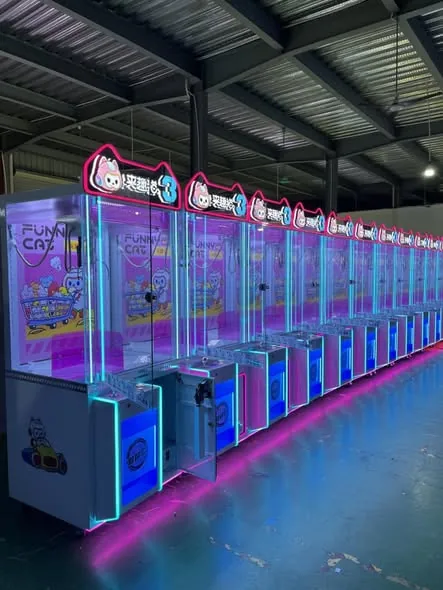
Not every claw machine in a lineup needs to do the same job. A strong mix usually combines dependable revenue machines, a few visually attractive feature machines, and enough variety to keep customers exploring.
For a first location, a standard single-player commercial machine is the easiest starting point — it handles common plush sizes, fits most venues, and is straightforward to restock and maintain. Compact and mini machines suit tighter spaces like restaurants, waiting areas and small shops, and their smaller prizes also reduce initial inventory cost. Dual-player machines let two customers play at once, and four-player island units increase playing capacity per square meter — useful in larger stores, malls and family entertainment centers. Transparent and LED-equipped cabinets serve a different purpose: placed near an entrance, a bright top light box or fully transparent shell pulls attention from a distance and functions almost as store signage. Large and giant machines work best as feature pieces for premium plush and mall atriums, though they demand more space, bigger prizes and higher shipping costs. A dedicated store shouldn’t rely on one repeated cabinet across the whole floor — mixing in scissor machines, clip machines, pinball and gashapon gives customers more reasons to keep browsing.
Em Chengjietian, for example, the standard Gen 1, Gen 2 and Gen 3 commercial machines typically serve as the core lineup — the Gen 2 adds an LED top light box, and the Gen 3 uses more prominent lighting with support for modern payment options. The larger Gen 3.5 suits bigger plush toys, the fully transparent Gen 4 is a common pick for modern themed stores, and the Gen 5 giant claw machine is built specifically as an attention-generating feature piece rather than a replacement for standard cabinets. The point isn’t chasing the newest generation — it’s matching the machine to the location, prize, available space and role it needs to play.
That matching extends to the claw itself. Small claws around 7.5-8.5 cm suit mini plush and small gifts; standard commercial machines commonly run 120mm, 140mm or 180mm claws; larger cabinets step up to 250mm, and giant machines can reach around 400mm. Bigger isn’t automatically better — a claw too large for the prize won’t close properly, and one too small won’t get enough grip to lift it, while a heavy, smooth-surfaced prize needs a different claw shape and strategy than a soft plush of similar size. Prize density matters too: pack the cabinet too tightly and the claw can’t descend or close on a target; leave it too sparse and the display looks unappealing while remaining items feel unreachable. Beginners often try to fix every playability issue by adjusting claw strength alone, but good playability really comes from how the prize, claw, machine settings and display all work together.
Set the Play Price, Prize Cost and Win Rate Together
Profitability here isn’t as simple as multiplying revenue by a win percentage. The actual structure is:
Revenue = Price per play × Number of plays
Prize cost = Number of prizes won × Average landed prize cost
Operating profit = Revenue − Prize cost − Venue cost − Payment fees − Maintenance − Other expenses
For example, a machine charging $1 per play with 600 plays in a month generates $600 in gross revenue. If sixty prizes are won at an average landed cost of $2.50 each, prize cost comes to $150 — and from there you still subtract venue share or rent, transaction fees, transportation and maintenance. The “landed” prize cost matters because it’s rarely just the supplier’s unit price; shipping, damaged stock, unusable items and promotional giveaways all add to the real number.
There’s no universal rule that a machine should pay out one prize every ten, fifteen or twenty-five plays — a mini machine with cheap prizes and a giant machine with expensive plush simply can’t run the same setting, and the right one depends on price per play, prize cost, venue cost, local regulations and the player experience you’re aiming for. Win too rarely and players stop trying (and tell others); win too easily and prize cost outruns the plan. The target is a machine that feels challenging but achievable.
Build a Prize Strategy Around the Customer
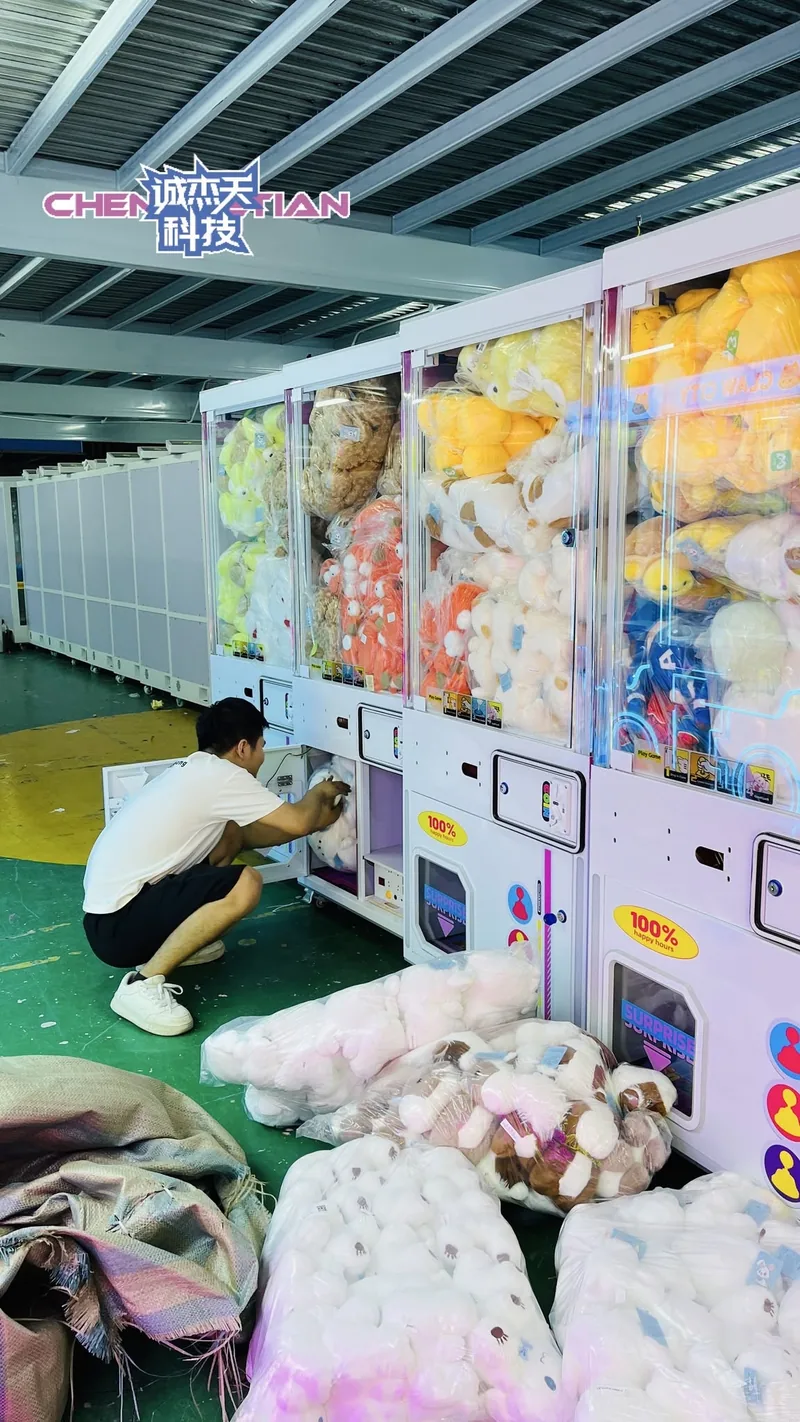
A prize doesn’t just need to be cheap — it needs to look valuable to the specific people playing. Children respond to colorful plush and familiar characters; teenagers and young adults lean toward anime figures, collectibles, keychains, beauty accessories or trending products; adult players are often drawn to practical or branded items with a premium look. The most expensive prize isn’t automatically the best performer — a low-cost item with high perceived value can outdraw a costly one that just doesn’t match the venue’s audience, and since prize trends shift quickly, it’s worth avoiding a large first order of any single design until demand is proven.
In a store setting, layering prize tiers helps: standard machines carry accessible, frequently refreshed prizes, larger or specialty machines showcase premium items, and scissor or clip machines handle boxed gifts or electronics that don’t suit a traditional claw. Presentation matters almost as much as selection — prizes facing the customer, popular designs kept visible, cabinets full but not overcrowded. A dusty machine stuffed with old, compressed plush won’t pull repeat players even if the win rate itself is perfectly fair.
Choose the Right Payment System
Cashless payment keeps growing in importance, but it isn’t automatically the right call everywhere — options run from coins, tokens and bill acceptors to QR codes, NFC, credit cards and centralized arcade card systems, and the right mix depends on the venue and local habits.
A dedicated store benefits most from a unified system, where customers load credits onto a card or account usable across every machine, which in turn makes promotions, memberships, bonus credits and sales reporting far easier to manage. A single machine in a restaurant or small shop is usually better served by something simpler — a coin or bill acceptor, or a local QR payment option.
Before committing to any card or mobile payment provider, confirm it actually operates in your country, and check transaction fees, settlement methods, technical support, and whether the machine keeps working through an internet outage. A payment system that works well in one country won’t necessarily transfer to another, and because cabinet openings, wiring and payment hardware are much harder to change after delivery, local payment habits should shape the machine configuration before it’s manufactured — not after.
Check Local Licenses and Regulations
Rules here vary widely by country, state, province and city — some places only require a standard business license, while others demand an amusement machine permit, per-cabinet registration, specific tax labels or inspections. Prize value can be regulated too, and how a machine is configured can affect whether it’s classified as skill-based entertainment or something closer to a game of chance, which carries different legal treatment.
Before opening, it’s worth confirming directly with the relevant local authority:
- Whether amusement machine permits are required
- Whether each machine needs individual registration
- Whether prize values are capped
- Whether cash prizes or gift cards are restricted
- Whether certain game settings are prohibited
- Whether liability insurance is required
- Which electrical or product certifications are accepted
Imported machines also need to match local voltage, frequency and plug standards. Manufacturers can typically provide CE or FCC documentation depending on the model and destination, and optional components like a UL-related power box should be discussed before production — but no single certificate should be assumed to cover every legal requirement in every market.
Prepare and Test Machines Before Opening
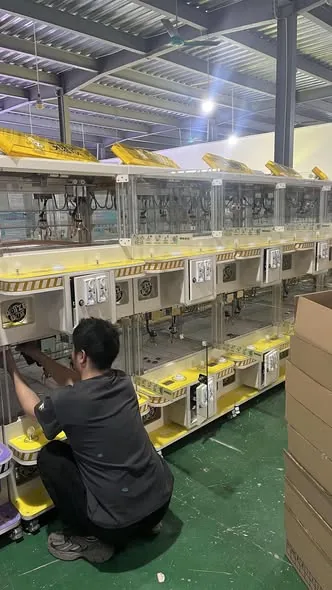
A commercial claw machine shouldn’t go straight into operation the moment it’s unpacked. Start with the basics — cabinet, glass, wiring, power supply, locks, joystick, buttons, payment device, prize sensor, claw movement and prize outlet — then run the gantry corner to corner to confirm smooth movement, and test the claw at the front, back and corners of the prize area to make sure it opens and closes cleanly with no twisted cabling.
Game time, claw strength, carrying strength, release position, sound level, credit settings and win-related parameters should all be tested with the actual prizes loaded, since a setting that looks fine in an empty cabinet often behaves differently once fully stocked. For larger orders, it’s worth asking the supplier about aging and continuous-operation testing before shipment — at Chengjietian, machines go through functional and aging testing pre-delivery, with remote technical assistance available for setup and troubleshooting. It’s also worth including a small set of practical spares in the first order — switches, buttons, sensors, fuses, claw strings, belts, power components and payment parts are inexpensive next to the revenue lost while a machine sits out of service.
Plan Daily and Weekly Operations
Claw machines don’t need constant supervision, but they’re not fully passive either. Glass, control panels, buttons, joysticks and prize outlets need regular cleaning — a clean cabinet makes the prizes look more valuable and gives players more confidence to try. Prize levels need monitoring too: a nearly empty machine looks neglected, an overfilled one gets harder to play fairly, and restocking should aim to preserve both appearance and fair claw access. Payment devices need periodic checks as well, since coin jams, bill acceptor errors, QR failures or empty card supplies stop revenue immediately.
It’s worth logging revenue, play counts, prize consumption, restocking dates, faults and venue payments as a matter of routine — without records, it’s easy to mistake high gross revenue for high profit. For a route business, organizing locations geographically and keeping a fixed service schedule cuts travel time and keeps every machine getting consistent attention.
Use the First 90 Days to Test the Business
Treat the first three months as a controlled test, not a verdict on whether the business works.
Days 1-30: establish a baseline. Track daily or weekly play volume, revenue, prize wins, prize cost, payment issues, customer feedback and service needs. Resist changing price, prizes, location and claw settings all at once — if everything moves together, there’s no way to tell what actually helped or hurt.
Days 31-60: fix the weakest link. Once there’s enough data, the main problem usually becomes clear. Customers noticing the machine but not playing points to price or prizes; playing once but rarely returning points to a game that feels unfair or uninteresting; strong revenue with high prize costs points to the prize mix or settings. Sometimes the issue is simply placement — moving a machine from a back wall to a visible waiting area can outperform any change to the cabinet or price. Make one significant change at a time and keep recording.
Days 61-90: decide whether to expand or relocate. By now there should be enough information to act on. Stable play volume, controllable prize costs and manageable servicing usually justify adding a second machine to the same venue or testing a similar location; good interest with weak profit points to a different prize structure, payment method or venue deal; low visibility and few plays point to relocating. There’s no reason to keep an unprofitable spot just because it took time to find — moving machines is one of the real advantages of the placement model.
Know When You’re Ready to Scale
Growth should follow stability, not a specific machine count. By the time expansion makes sense, you should know which prizes actually sell, how often machines need service, how venue payments settle, and how much profit is left after every operating cost — plus enough cash reserve to stock new machines without straining existing ones.
The safest next step often isn’t a second store. It might just be a second machine at a location that’s already proven itself, or diversifying an existing spot with a mini machine, a transparent feature unit, a dual-player cabinet, a scissor machine or a gashapon unit rather than adding more identical cabinets. Remote sales monitoring and fault alerts can help manage a larger fleet, but they don’t replace physical inspection, cleaning, prize arrangement and maintenance.
Common Mistakes to Avoid
- Buying too many machines before proving a location. Bulk orders lower the per-unit shipping cost, but that saving is meaningless without suitable places to put the machines.
- Choosing by appearance or price alone. An attractive cabinet with unreliable electronics creates frequent downtime, and a cheap machine without spare parts or support gets expensive fast after the first fault.
- Mismatching the prize to the machine and claw. Buying machines first and figuring out what to put in them later is one of the most common causes of poor playability.
- Copying another store’s win settings. A setting that works elsewhere assumes the same price, prize cost, rent and customer expectations — rarely a safe assumption.
- Mistaking a busy opening week for normal performance. New locations often see a short curiosity spike; long-term results depend on repeat customers, prize refreshes, fair playability and consistent operation.
A good machine can’t rescue a poor location, but a good location can still lose money if the machine, prizes, payment method and settings don’t line up with it.
Perguntas mais frequentes
How much money do I need to start a claw machine business?
It depends on the model. A single-machine test can run to a few thousand dollars once shipping, payment equipment, prizes, venue costs, permits and reserve cash are included. A three-to-five-machine route needs more capital but can benefit from combined shipping and shared spares. A dedicated store typically starts in the mid-five-figure range once rent, deposits, decoration, staff, payment systems and marketing are factored in.
Can I start with just one machine?
Yes — it’s a practical way to learn prize selection, customer behavior, maintenance and venue cooperation before committing more capital. Just keep in mind that one machine in one location isn’t enough data to judge the whole business model; a weak result may say more about the location than the industry.
What’s the best claw machine for a beginner?
A standard single-player commercial machine — it holds common plush sizes, is easy to understand, and works in most venues. A mini machine suits tighter spaces. Transparent and giant machines are eye-catching but usually work better as feature pieces once you already understand the local market.
How many machines does a claw machine store need?
A small store might open with eight to twelve, a larger one twenty or more — but the floor plan matters more than the raw count. Customers need comfortable aisles, clear sightlines, easy access to the counter, and enough clearance around larger machines.
Do I need a license to operate a claw machine?
Possibly — requirements vary by location and can depend on machine settings, prize value, and whether the game is classified as skill-based. Check with local business, amusement, gaming, tax and safety authorities before opening.
How often should machines be restocked?
High-traffic machines may need daily checks and frequent restocking; lower-volume spots can often be serviced weekly. Base the schedule on prize consumption and appearance rather than waiting until the cabinet is nearly empty.
Are cashless payments necessary?
Increasingly useful, but not mandatory everywhere. The right system — coins, bills, QR, card, NFC, or a centralized arcade credit system — depends on local payment habits and venue type.
How long does it take to recover the initial investment?
There’s no reliable universal number. Payback depends on machine cost, location performance, prize expenses, venue share, payment fees and local operating costs — actual results from the first 60-90 days are a far better guide than any fixed timeline promised online.
Considerações finais
Starting a claw machine business isn’t really about finding the cheapest machine or the most eye-catching cabinet. The real work is choosing a business model, validating a location, understanding the players, and calculating the full landed and operating cost — then selecting machines based on available space, prize size, customer group, payment habits and the role each one needs to play.
A beginner may need nothing more than one dependable standard machine. A small route may need compact, easy-to-service models. A dedicated store usually needs a balanced mix of standard machines, dual-player cabinets, transparent units, a giant feature machine, and a few alternative prize games to round things out. Before requesting a quotation or store plan, it helps to have the basics ready — country, business model, available floor area, expected machine count, prize type, payment method and opening timeline. The more clearly those details are defined, the easier it is to build a claw machine business that’s practical to run, appealing to customers, and built for sustainable returns.
For factory-direct pricing and machine recommendations tailored to your business model, contact Chengjietian today or explore our complete range of commercial claw machines.


