Krazy Claw Arcade Case Study: A 200 m² Claw Machine and Prize Arcade in Mesa, Arizona
Congratulations to our customer on the official opening of Krazy Claw Arcade on July 16, 2026, at Superstition Springs Center in Mesa, Arizona! Located near the food court on the second floor of the mall, the store welcomed its first visitors with a four-day grand opening celebration. From floor planning and machine selection to brand customization and final installation, Chengjietian supported the project from concept to completed store — turning a roughly 200-square-meter space into a full-scale claw machine and prize arcade.
Project Background: What the Customer Set Out to Build
Krazy Claw Arcade was never planned as a simple room full of claw machines. The customer’s goal was a long-term entertainment business with its own recognizable brand, built around claw machines but supported by a wider mix of prize and instant-win games — scissor machines, capsule toy machines, pinball, and prize pushers among them. This variety matters commercially as much as visually: a store filled with one machine type gives visitors little reason to stay, while a mix of grabbing, cutting, clipping, and capsule-toy games spreads play prices across different budgets and keeps repeat visits interesting.
The business plan also went beyond gameplay. A beverage bar and seating area were built into the layout so parents could rest while children played, and so groups of friends or family had a reason to linger rather than leave after a few rounds. Superstition Springs Center itself reinforced this direction — as a family-oriented mall with restaurants, a cinema, and children’s activities, a location near the food court put the store in front of families, teenagers, and diners waiting for a table, exactly the mix of customers a hybrid arcade-and-lounge concept is built to convert.
Planning a 200 m² Store That Works for the Business, Not Just the Machines
For a claw machine arcade, packing in the maximum number of machines is rarely the right instinct — rows placed too tightly restrict customer movement and make daily restocking and maintenance harder than it needs to be. For Krazy Claw Arcade, Chengjietian completed the floor plan and 3D design before the final machine count and placement were confirmed, so the layout was built around how customers and staff would actually move through the space, not around fitting in as many units as possible.
Claw Machine and Prize Game Area

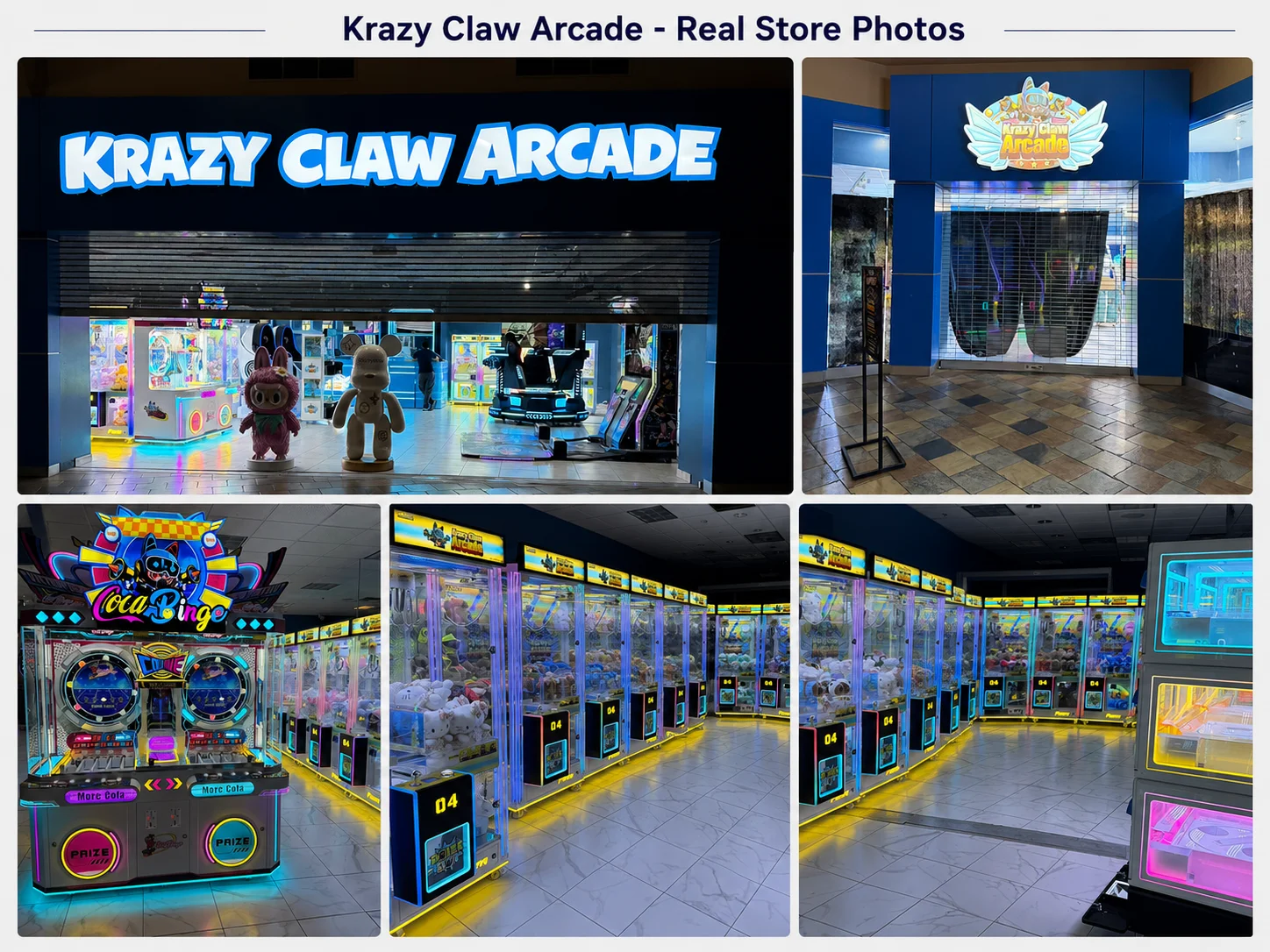
The main game area occupies the left side of the store, with machines placed along the walls and additional rows arranged island-style through the center. Wall-mounted machines create a continuous run of lighting and let customers browse prizes easily as they walk in, while the center rows accommodate different machine sizes and game types so the floor doesn’t read as repetitive. In the completed store, blue, yellow, and pink lighting ties these rows together into one cohesive gaming area, giving the arcade a strong visual identity even under the dim lighting typical of amusement venues.
Beverage Bar and Seating Area
The beverage bar, service counter, and customer seating sit on the right side of the store, deliberately separated from the machines to keep drinks away from the equipment. Seated customers can still see into the gaming area, which lets parents supervise children while they rest. Seating takes up floor space that could otherwise hold more machines, but for a family-oriented arcade inside a mall, that tradeoff supports longer visits and higher per-visit spending — which matters more to the business than an extra unit or two on the floor.
Storage and Office Space
Roughly 45 m² at the rear of the store was reserved for plush toys, blind boxes, capsule toys, and other prize inventory, alongside a separate office for cash handling, inventory records, and machine reports. Prize arcades need frequent restocking, and without dedicated storage, product tends to pile up around the counter or along customer walkways — undermining both the store’s appearance and the efficiency of daily operations. Planning this space into the original layout, rather than solving it after opening, is what keeps the front of house looking finished.
Machine Configuration and Game Mix
The final layout included approximately 32 amusement machines and service units, built around a small number of core revenue machines supported by a wider range of prize formats.
| Machine Type | Planned Quantity | Main Purpose |
|---|---|---|
| Plush Claw Machines | 20 units | Core revenue machines for plush toys and regular prizes |
| Clip Prize Machine | 1 unit | Suitable for hanging or boxed prizes |
| Scissor Gift Machines | 2 units | Used for higher-value prize challenges |
| Arcade Prize Machines | 2 units | Add more instant-win game options |
| Three-Level Capsule Toy Machines | 3 units | Suitable for capsules, blind boxes, and collectibles |
| Prize Pusher Machines | 2 units | Increase game variety and repeat play |
| Token Changer Machine | 1 unit | Reduces manual token exchange work |
| Counter Token Changer | 1 unit | Supports customer service and token exchange at the counter |
Plush claw machines make up the bulk of the floor and drive both the store’s core revenue and its visual impact from the entrance. Scissor and clip prize machines sit at a higher price point for customers chasing bigger prizes, while capsule toy machines offer a lower entry price that draws in casual and younger players. Prize pushers and the remaining arcade machines round out the mix, giving repeat customers a reason to keep playing rather than stopping after one game type. All machines were configured for the customer’s local 110V system, with rated power for each machine type considered during planning so the customer could size circuits and outlets accordingly — though final electrical capacity and installation should always be confirmed on-site by a qualified local electrician.
Building a Consistent Brand Identity
Across the store, the machines function as more than equipment — they’re part of the interior design. Krazy Claw Arcade‘s dark blue storefront, illuminated logo, and matching yellow header panels give the space a unified look rather than a row of unrelated machines, which reduces visual clutter and makes the store instantly recognizable in customer photos and social posts — a meaningful advantage for a mall tenant that depends partly on word of mouth and foot traffic.
The customized elements carried across the store included:
- Main store color scheme — a consistent blue theme applied to the storefront and machine bodies
- Krazy Claw Arcade logo application — used on the entrance sign and machine headers alike
- Customized illuminated machine headers — keep the branding visible even in low mall lighting
- Machine decals and numbering — help staff and customers identify machines quickly
- Coordinated lighting across the game area — ties separate machine rows into one visual space
- Consistent branding across storefront, machines, and promotional materials — reinforces recognition beyond the store itself
Individually, each of these is a small production detail. Applied consistently across every machine and the storefront, they’re what make the finished arcade look like one designed venue rather than a collection of separately purchased machines.
From Concept to Completed Store
Before production began, Chengjietian prepared a floor plan based on the store’s dimensions, entrance position, and required functional areas, followed by a 3D rendering so the customer could review machine layout, colors, and storefront branding ahead of time. This step exists to catch layout problems early — during actual installation, machine positions often still need adjustment for walls, emergency exits, fire safety requirements, and existing electrical outlets, so the 3D design is best understood as a planning tool rather than an exact preview of the final site.
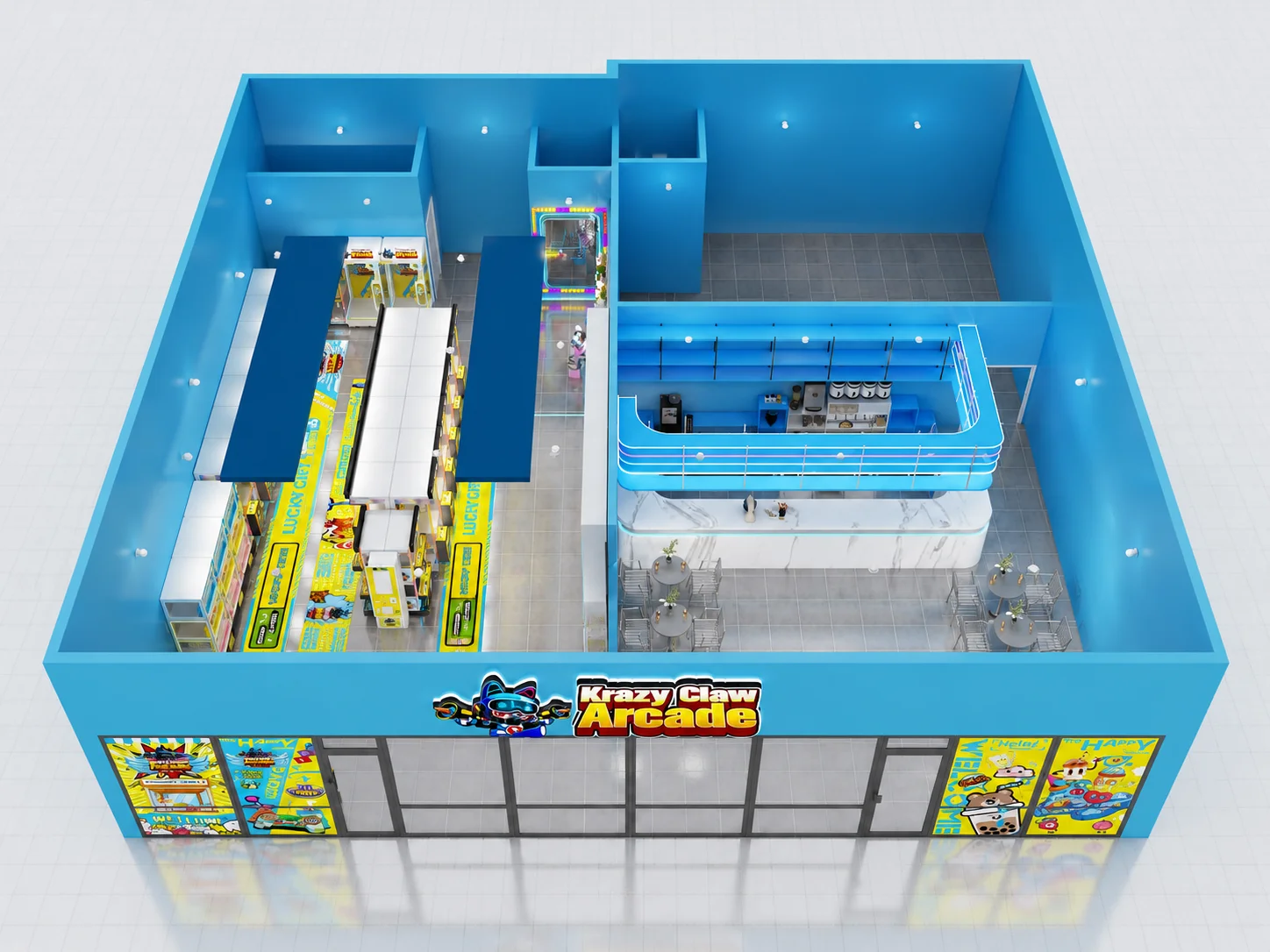
That process carried through to the finished store. The completed Krazy Claw Arcade retained the blue visual theme from the original concept, with rows of customized machines, matching header panels, and yellow base lighting creating the same continuous branded appearance the 3D design had proposed — evidence that the planning stage did what it was meant to do.
Grand Opening: Turning Foot Traffic Into Paying Customers
From July 16 to July 19, 2026, Krazy Claw Arcade ran a four-day grand opening celebration promoted through the shopping center’s official event channels, giving the new store visibility beyond passing mall traffic. During the promotion, customers earned 1.5 times the regular game credits for every dollar spent, stackable with the arcade’s existing recharge packages.
The opening days also included targeted gifts and giveaways:
- Free $15 or $30 game cards for a limited number of early customers — lowers the barrier for first-time visitors to try the store
- Free capybara plush toys with qualifying purchases — rewards a specific spending threshold
- Free Stitch or Hello Kitty plush toys with qualifying purchases — adds variety to the purchase incentive
- Free Labubu blind boxes for customers who reached the required spending amount — targets higher-spending visitors specifically
Each offer served a different purpose rather than simply discounting play: free game cards got first-time visitors through the door, bonus credits encouraged larger recharges, and the plush and blind box gifts gave customers a concrete reason to reach a higher spending target. For a newly opened arcade, that structure does more than generate an opening-week sales bump — it also gives the operator early data on which machines and prizes local customers respond to most.
Key Takeaways for Arcade Investors
The Krazy Claw Arcade project illustrates a few decisions that matter beyond this single store:
- Finalize the layout before locking in machine quantities — ordering machines ahead of a confirmed floor plan risks narrow walkways, misplaced outlets, and underused space that’s costly to fix later.
- Reserve storage space from the start — a steady supply of replacement prizes needs a home; treating storage as an afterthought pushes inventory into customer areas.
- Mix machine and prize types deliberately — different games support different price points and play styles, which keeps the store from feeling repetitive.
- Keep the storefront and machines visually consistent — matching colors, headers, and lighting make the arcade look more professional and easier to recognize.
- Design the grand opening around a conversion strategy, not just a discount — free trials, recharge bonuses, and spending-based gifts each move customers toward a different outcome.
How Chengjietian Supports Arcade Projects
Krazy Claw Arcade was planned as a complete business space, not a list of machines to purchase — and that’s the approach Chengjietian brings to every claw machine arcade, prize arcade, or family entertainment center project. Services include:
- Floor plan and machine layout recommendations
- Machine quantity and game mix planning
- 3D store design services
- Plush claw machines, scissor machines, clip prize machines, capsule toy machines, pinball machines, and other prize arcade equipment
- Machine color, logo, header panel, and decal customization
- Voltage and payment system configurations for different countries
- Factory testing, game setting guidance, and remote technical support
A successful arcade layout isn’t about maximizing machine count — it’s about balancing gameplay, customer flow, prize storage, branding, and staff operations into one space that works on opening day and keeps working after it. The completed Krazy Claw Arcade, from its original floor plan through its four-day grand opening, is one example of Chengjietian carrying that balance from concept through to a real, welcoming venue.
Interested in opening your own claw machine arcade? Read our guide on how to start a claw machine business, check out whether claw machines are profitable, or browse more case studies from our projects worldwide.